Quick answer: Breaking phone addiction is habit replacement, not abstinence: identify the 2–3 apps driving the compulsion, put them behind a block with no free bypass, and channel the checking urge into activities that earn access back. The compulsion fades when checking stops paying off instantly — typically within a couple of weeks of consistent friction. (For genuine distress or functional impairment, talk to a professional — an app is a tool, not treatment.)
First, drop the shame — it's load-bearing for the addiction
The cycle usually looks like: compulsive use → guilt → stress → and then the phone again, because the phone is your fastest stress relief. Shame doesn't exit the loop; it fuels it. Every effective approach starts from the same reframe: your attention is being farmed by professionals; installing better defenses isn't weakness, it's maintenance.
Understand the loop you're breaking
Compulsive checking is a textbook habit loop: a cue (boredom, anxiety, a hard task, an elevator), a routine (unlock, open app, scroll), and a variable reward (usually nothing, occasionally something great — the unpredictability is the hook). Two properties matter for breaking it:
- The loop runs below awareness. You're mid-scroll before you've decided anything. Any fix must work without your participation in the moment.
- The loop survives punishment but not futility. Making checking painful creates struggle; making it not pay creates extinction. The check has to hit a wall, calmly, every time.
The replacement protocol
- Find your real triggers. Three days of honest observation (Settings → Screen Time → Pickups helps): when do the compulsive opens cluster? Waking, transitions, bedtime, hard tasks?
- Wall off the 2–3 compulsion apps. Not your whole phone — the specific slot machines. In FocusFirst they go behind a Screen Time shield with no ignore button. The reflexive check now meets a calm wall: "Spend earned time to unlock?" A reflex can't answer that; it just… ends.
- Give the urge a paying job. This is the step every failed detox skips. Choose focus apps that genuinely pull you — reading, a language, a project — and let time in them earn your scroll time back. The urge to check becomes the engine that funds the person you're trying to be. Restriction without replacement is willpower theater; this is the replacement.
- Reward consistency, forgive lapses. Streak multipliers in FocusFirst boost your earning rate for showing up daily — and a missed day simply pauses the bonus. No red flames, no broken-streak grief. Systems that punish lapses get deleted during lapses, which is precisely when you need them.
- Watch the identity shift, not just the numbers. Week-over-week focused hours in the Progress tab are the real signal. Somewhere around week three, something changes: you stop feeling like an addict being managed and start feeling like a person with a reading habit whose phone happens to cooperate.
What a realistic recovery looks like
Week 1: phantom urges, frequent shield encounters, mild indignation. Normal. Week 2: reflexive opens drop sharply — extinction working. Week 3–4: earned time often goes partly unspent; the balance was the security blanket, not the scrolling. Beyond: the phone is a tool with a couple of well-priced entertainment channels, and your evenings have hours in them again. Not a cure — a renegotiation. But it holds, because nothing in it depends on you being strong at 11pm.
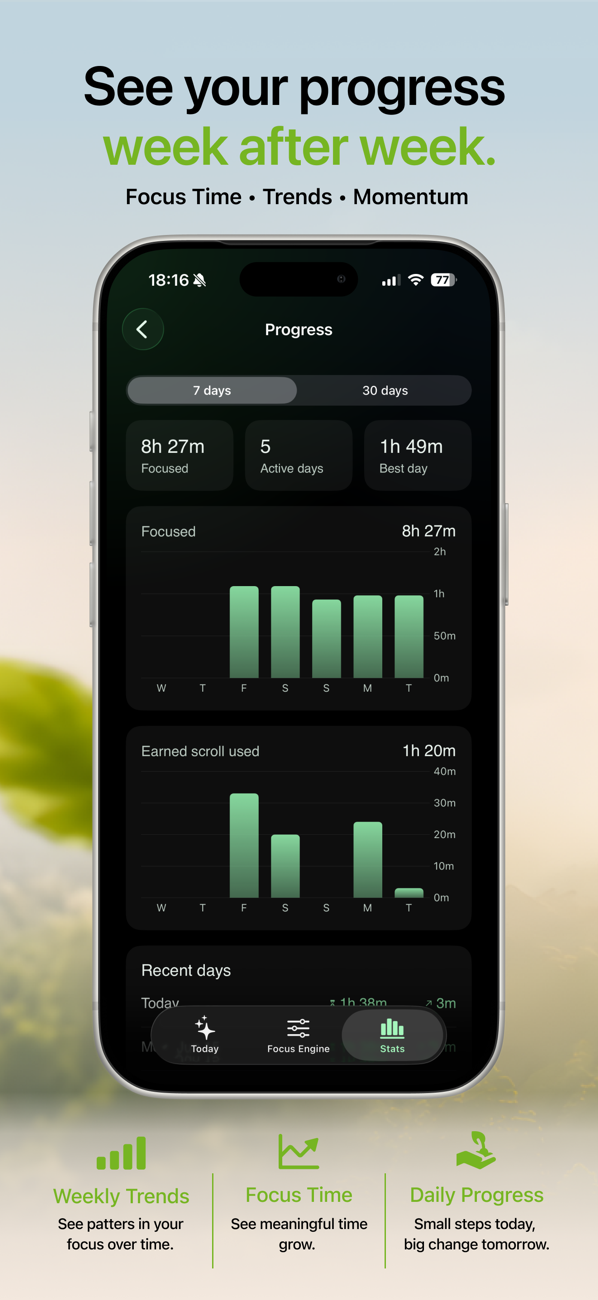
Try it: FocusFirst requires a subscription or one-time Lifetime purchase — block your distracting apps, set your earning rate, and start your first focus session today. Get FocusFirst for iPhone →